
First and foremost, developing an effective digital marketing strategy for a small business is essential for long-term online growth. However, running a small business often feels like wearing ten different hats at once. Indeed, between managing operations, customer service, and finances, finding time to market your business online can feel overwhelming.
Unfortunately, many small business owners fall into the trap of “random acts of marketing”—posting occasionally on Instagram, running a brief Facebook ad, or tweaking their website—without a unified plan. As a result, they end up with wasted time, inconsistent leads, and little return on investment (ROI).
Fortunately, learning how to create a digital marketing strategy for a small business doesn’t require a six-figure budget or a full agency team. Instead, it requires a clear, repeatable process that aligns your business goals with the channels your target customers actually use.
In this step-by-step guide, you’ll discover a streamlined, actionable framework to build a cost-effective small business digital marketing strategy from scratch.
What Is Digital Marketing Strategy for a Small Business?
A digital marketing strategy is a structured blueprint that outlines how your business will use online channels—such as search engines, social media, email, and websites—to attract, engage, and convert prospective customers.
Unlike large enterprises with multi-million dollar budgets, a small business marketing roadmap must prioritize efficiency, agility, and measurable ROI. Therefore, instead of trying to be everywhere at once, an effective strategy focuses only on high-impact channels.
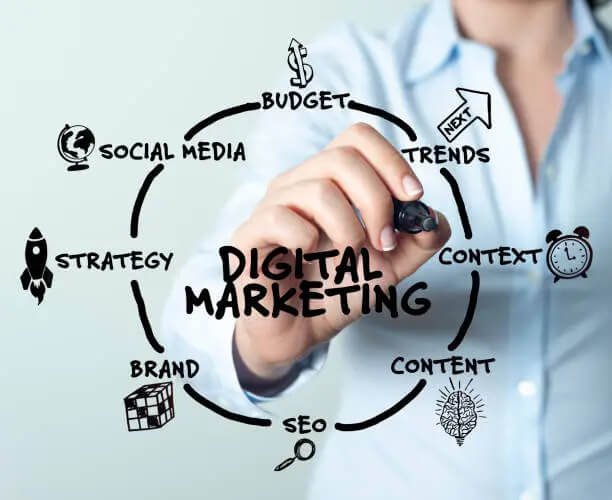
Strategy vs. Tactics: Understanding the Difference
- Strategy: Your overarching goal and roadmap (e.g., “Generate 30 qualified local service leads per month by building local search authority and an automated email follow-up process.”)
- Tactics: The specific actions you take to achieve that strategy (e.g., “Publishing two SEO blog posts a month,” “Optimizing Google Business Profile,” or “Sending a weekly newsletter.”)
Ultimately, without a strategy, your tactics become disconnected tasks that rarely deliver sustainable growth.
Step 1: Define Goals for a Digital Marketing Strategy for a Small Business
Every successful strategy begins with the end in mind. Before spending money on ads or hours on social media, define what success looks like for your business.
Use the SMART Framework
Avoid vague ambitions like “get more sales.” Instead, set S.M.A.R.T. goals (Specific, Measurable, Achievable, Relevant, Time-bound):
- Weak Goal: “I want more website traffic.”
- SMART Goal: “Increase organic website traffic by 35% over the next 6 months to generate 20 new inbound sales inquiries monthly.”
Common Small Business Objectives
Depending on your business model, prioritize one or two primary goals:
- Local Service Businesses: Drive phone calls, contact form fills, and local foot traffic.
- E-commerce Stores: Increase online checkout conversions, average order value (AOV), and repeat purchases.
- B2B / Professional Services: Build email subscriber lists and schedule qualified consultation calls.
Step 2: Identify and Understand Your Target Audience
Marketing to “everyone” means marketing to no one. Small businesses succeed by speaking directly to a specific audience persona.
How to Build a Buyer Persona
A buyer persona is a semi-fictional representation of your ideal customer based on data and real feedback. To build your persona, answer these core questions:
- Demographics: What is their age, location, income level, and job title?
- Pain Points: In particular, what immediate problems are they trying to solve?
- Goals: Most importantly, what outcome are they looking for when searching for your product or service?
- Online Habits: Where do they get their information? (e.g., Google search, LinkedIn, Instagram, Reddit?)
Example: For instance, a boutique residential HVAC company shouldn’t market to “homeowners.” Their ideal persona might be “Suburban Homeowner Sarah,” aged 35–55, who values energy efficiency, fast response times during seasonal breakdowns, and upfront pricing.
Step 3: Audit Your Current Online Presence
Before building new marketing campaigns, evaluate your existing digital assets to identify what is working and what needs repair.
Key Areas to Audit
- Your Website: Is it mobile-friendly, fast-loading, and easy to navigate? Moreover, does every page have a clear Call to Action , or are you looking for effective Call to Action (CTA) examples to improve conversions?
- Local SEO & Google Business Profile: Is your business profile fully optimized with accurate Business Name, Address, and Phone number (NAP) to optimize your Google Business Profile?
- Social Media Channels: Which platforms have active followers? Which ones are dormant and wasting time?
- Analytics: Do you have Google Analytics 4 (GA4) and Google Search Console installed to track visitor behavior according to Google Search Central guidelines?
Step 4: Choose the Right Marketing Channels for Your Small Business (Quality Over Quantity)
One of the biggest mistakes small businesses make is spreading themselves too thin across every platform available. Instead, master 2 to 3 channels where your audience is most active.
| Channel | Best For | Primary Advantage |
|---|---|---|
Search Engine (SEO) |
Long-term sustainable traffic |
Captures high-intent buyers |
Local SEO (Google Maps) |
Brick-and-mortar & local services |
High conversion rate for local search |
Email Marketing |
Nurturing leads & repeat sales |
Highest average ROI ($36 per $1) |
Social Media Marketing |
Brand awareness & engagement |
Visual proof & community building |
Paid Search (Google Ads) |
Instant visibility & quick leads |
Immediate access to ready buyers |
Core Digital Channels Breakdown
1. Search Engine Optimization (SEO) & Local SEO
Search Engine Optimization (SEO) & Local SEOSEO ensures your business appears when potential customers search for solutions on Google. In particular, for local businesses, optimizing your Google Business Profile, implementing proven local SEO strategies and getting customer reviews is often the fastest path to inbound calls.
2. Content Marketing
Likewise, creating helpful blog posts, video guides, and FAQs positions your business as an industry authority. In short, good content solves customer problems before asking for a sale.
3. Email Marketing
Email remains one of the most profitable marketing channels according to industry email marketing statistics, because you own your audience list without relying on third-party social media algorithms. Therefore, build a simple lead magnet (e.g., a downloadable guide, discount code, or checklist) aimed at building an email subscriber list to collect visitor email addresses.
4. Targeted Paid Advertising
On the other hand, if you need immediate traffic, platforms like Google Ads and Meta (Facebook/Instagram) Ads allow you to target precise demographics, geographical locations, and search intents on small daily budgets.
Step 5: Allocate a Realistic Budget and Resources
You do not need thousands of dollars a month to get started. However, you must align your expectations with your available time and financial investment.
Budgeting for a Digital Marketing Strategy for a Small Business
- Bootstrapping / Organic Focus: If you are just starting out, a realistic operational budget of $300 – $1,000 per month can cover essential software, basic content creation, and small paid ad experiments.
- Growth / Paid Focus: 7% to 12% of total business revenue allocated toward active marketing campaigns, aligning with SBA business budget recommendations.
Time Allocation vs. Budget
- If you have time but little money: Focus on organic SEO, Google Business Profile optimization, content creation, and networking.
- If you have budget but limited time: Focus on targeted search ads, hiring freelance specialists, or using marketing automation tools.
Step 6: Create an Actionable Content & Campaign Plan
Consistency beats intensity. Build a monthly content calendar so you are never left guessing what to post or publish.
Sample Digital Marketing Strategy for a Small Business
- Week 1: Publish 1 helpful blog post solving a common customer question; send a monthly newsletter summarizing key tips and promotions.
- Week 2: Collect and post 2 customer video testimonials or before-and-after photo cases on social media and Google Business Profile.
- Week 3: Audit and optimize top-performing landing pages for local search terms; launch a low-budget retargeting ad campaign.
- Week 4: Review analytics, track conversions, and plan the upcoming month’s calendar based on data.
Step 7: Measure Performance and Optimize
What gets measured gets managed. Review your marketing performance monthly to double down on what works and cut tactics that underperform.
Key Metrics (KPIs) to Watch
- Traffic Sources: Where are your visitors coming from? (Organic, direct, paid, social)
- Conversion Rate: What percentage of website visitors take action (fill out a form, buy, call)?
- Cost Per Lead (CPL): How much does it cost to acquire a new prospective client when calculating customer acquisition cost?
- Return on Ad Spend (ROAS): How much revenue did your paid campaigns generate versus what you spent?
Real-World Examples: Small Business Digital Strategies
Example A: Local Plumbing & HVAC Service
- Primary Channel: Google Local Services Ads & Google Business Profile.
- Strategy: Capture high-intent emergency searches (“plumber near me”).
- Tactics: Collect 50+ 5-star reviews, optimize map listings, run search ads during peak seasonal transitions, and offer instant online booking.
Example B: Niche E-Commerce Brand (Handcrafted Leather Goods)
- Primary Channel: Instagram/TikTok & Email Marketing.
- Strategy: Build visual brand identity and retain repeat buyers.
- Tactics: Post behind-the-scenes craft videos, offer a 10% discount for email signups, and send automated cart recovery emails.
Common Small Business Marketing Mistakes to Avoid
- Ignoring Mobile Users: Over 60% of web traffic comes from mobile devices. Consequently, if your website is hard to navigate on a phone, potential clients will bounce immediately.
- Chasing Every New Social Media Trend: Don’t waste energy launching channels your primary customers do not use. Instead, focus only on channels where your ideal customers actually spend time.
- Failing to Collect Customer Reviews: Social proof is crucial. After all, a business with zero reviews will consistently lose ground to competitors with active customer feedback.
- Giving Up Too Early: Organic search and content strategies take 3 to 6 months to gain momentum. Therefore, consistency is key.
Frequently Asked Questions (FAQs)
How much should a small business spend on digital marketing?
Most small businesses allocate between 7% and 12% of their total revenue to marketing. If you are just starting out, a realistic operational budget of $300 to $1,000 per month can cover essential software, basic content creation, and modest paid ad experiments.
What is the best digital marketing channel for small businesses?
For local service businesses, Google Business Profile and Local SEO offer the highest ROI. For e-commerce and visual brands, Social Media (Instagram/TikTok) combined with Email Marketing typically yields the best results.
How long does it take to see results from digital marketing?
Paid ads (Google Ads or Social Ads) can generate leads within 24 to 48 hours. Organic methods like SEO and content marketing generally take 3 to 6 months to build domain authority and consistent organic search traffic.
Can I manage digital marketing myself, or should I hire an agency?
When starting out, most small business owners manage basic channels themselves using user-friendly tools. As revenue grows, outsourcing specific specialized tasks (like paid ad management or technical SEO) to freelancers or an agency frees up your time to focus on core operations.
Do small businesses really need a website, or is social media enough?
Yes, a dedicated website is essential. Social media platforms can change their algorithms or accounts at any time. Above all, a website gives you complete control over your brand, content, lead capture forms, and organic search traffic.
Ready to Scale Your Small Business Online?
Stop relying on “random acts of marketing.” If you need help building a structured, cost-effective digital marketing plan tailored specifically to your business goals, we are here to help.